
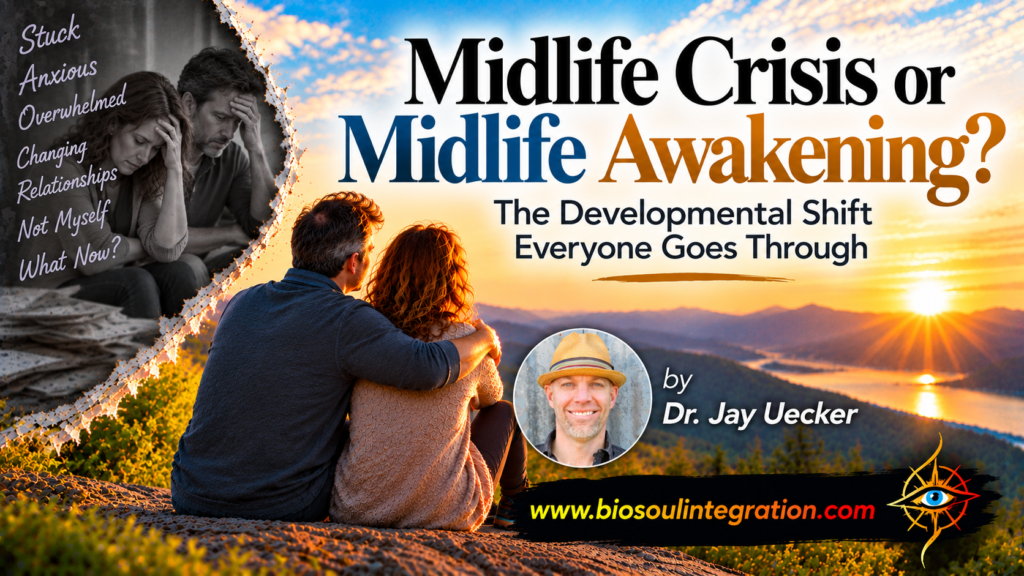
Midlife Awakening: Understanding the Transformational Journey Beyond Crisis

We cannot live the afternoon of life according to the programme of life’s morning.
Carj Jung, father of psychology
When Everything Feels Like It’s Falling Apart
A midlife awakening can feel, at first, like everything is falling apart.
Maybe the work that once lit you up doesn’t anymore.
Maybe a relationship is changing shape.
Maybe you’re carrying pain, anxiety, or a wave of emotion that seems to come from nowhere.
Or maybe nothing is obviously wrong, and yet there’s a quiet, persistent sense that the life you’ve built no longer fits.
Our culture has a name for this.
We call it a midlife crisis.
I’d like to offer another possibility: that nothing is going wrong at all, and that life itself is initiating a natural shift.
What Is a Midlife Awakening?
If you prefer to listen to audio podcasts, the BioSoul Integration Podcast and this episode can be found wherever you listen to your audio podcasts:
A midlife awakening is a developmental transition in which the identity, motivations, and ways of being that carried you through the first half of adulthood begin to loosen, and something deeper begins to emerge.
It often arrives through disruption.
Work loses its charge.
Relationships change.
The body speaks up.
Old feelings resurface.
From the perspective I work from at BioSoul Integration, this isn’t a malfunction.
It’s a passage.
We readily accept that children move through stages: learning to walk, learning to talk, then puberty reorganizing everything.
Development doesn’t stop at 18 or 21.
Life keeps evolving us, and midlife is one of its most significant turning points.
Midlife Awakening vs. Midlife Crisis

The two experiences can look identical from the outside, and both can feel painful from the inside.
The difference is in how we understand what’s happening and how we meet it.
A crisis is usually read as a problem to solve: something broke, so fix it, escape it, or get back to who you were.
An awakening is read as a process to participate in.
The disruption may be just as real, and things may genuinely fall apart.
But the falling apart may be happening because a structure built for an earlier stage of life can’t carry you into the next one.
Signs of a Midlife Awakening
Every awakening looks a little different, but many people recognize some combination of these:
- The old motivation is gone. Work or goals that once drove you feel flat, and pushing harder doesn’t bring the spark back.
- Your identity feels shaky. Roles you’ve held for decades, such as provider, caretaker, professional, or the one who holds it all together, stop feeling like the whole truth of you.
- Relationships are shifting. You have less tolerance for old dynamics and a stronger pull toward honesty and depth.
- Old emotions resurface. Anger, grief, or vulnerability you thought you’d moved past rise up unexpectedly.
- Your body is asking for attention. Pain, fatigue, anxiety, or overwhelm may appear alongside the questions.
- Things you ignored are now impossible to ignore. A creative pull, a longing for meaning, a sense that something wants to emerge.
- A persistent feeling that your life doesn’t fit anymore, even when it looks fine on paper.
If several of these sound familiar, you may not be broken.
You may be in the middle of a transition.
Why a Midlife Awakening Happens
A Life-Initiated Shift
After more than twenty years of working with people, and through my own experience, I’ve come to think of this process as a Life-Initiated Shift.
Life naturally asks us to become more embodied as we develop.
To inhabit more of ourselves.
To bring our attention down out of constant thought and rest it in the body.
As we feel safe enough to do that, we gain access to the life-force intelligence that animates the body, and really all living things.
And then something interesting happens.
Impulses begin to arise that don’t seem to come entirely from the conscious personality.
Something wants to change.
A direction emerges.
Over time you may sense that life is moving through you, and that you’re not creating the whole process but participating in an intelligence already at work.
Seen this way, a midlife awakening is less something happening to you and more something life is doing through you.
Our task is to learn how to participate.
A Process, Not a Moment

From the BioSoul Integration perspective, development tends to unfold in roughly seven-year stages, and the arc of a midlife awakening, from the first disruption through integration, can span about two of them.
That’s roughly fourteen years.
So a midlife awakening usually isn’t one dramatic Tuesday afternoon.
It’s a season.
When the Old Identity Loses Its Support
The first half of adulthood is largely about building a life and establishing an identity in the world.
For some of us that’s organized around career, achievement, providing, and proving ourselves.
For others it’s centered on relationships, raising children, caretaking, and being needed.
Usually it’s some of both.
Our whole system organizes itself around the roles that stage asks of us, including how we think, what motivates us, how we behave, and, in the framework I work from, how life-force energy moves through us.
At midlife, that scaffolding begins to weaken.
Life stops funding the old structure in quite the same way.
And the questions arrive: Who am I if I’m not holding all of this together? Who am I if I’m not doing this anymore?
The Role of Hormones

Hormonal changes are part of this picture.
Hormones influence how we feel, what motivates us, what we desire, and what seems important.
Think of puberty: the chemistry changes, and suddenly your body, interests, and whole way of seeing the world change with it.
Midlife involves another significant reorganization, most visibly in women through perimenopause and menopause, and more gradually in men.
In the perspective I work from, these physical changes are one expression of a larger developmental movement rather than the whole explanation.
Either way, when the chemistry that supported an earlier orientation to life shifts, it makes sense that direction and motivation shift too.
Things that once mattered lose their charge.
Things ignored for decades become impossible to ignore.
The Deeper Layer: Survival Patterns and the Parts of You That Return

There’s another dimension to a midlife awakening that rarely gets discussed, and it has to do with how our patterns begin.
Our nervous systems start taking in the world before we’re born.
From the earliest days, we absorb how the people around us relate to anger, grief, joy, love, vulnerability, and power.
We learn what’s safe to feel and express, and what isn’t.
Those patterns were handed to our parents by their parents, their families, and their culture.
So long before we can think about it, we learn this is how you be human, and this is how you belong.
Belonging is tied to survival, so we adapt automatically.
If anger isn’t safe, we push anger away.
If grief overwhelms the people around us, we may learn not to grieve.
If being powerful threatens connection, we make ourselves small.
If having needs isn’t safe, we learn not to need.
None of this is a conscious choice.
Our system adapts so we can survive and belong.
In the BioSoul framework, the life-force energy associated with those excluded parts becomes bound, held in the system as potential energy.
It doesn’t disappear.
It holds vitality, intelligence, and wisdom we haven’t yet had access to.
At midlife, the developmental task changes.
What helped you survive the first half of life may become what limits you in the second.
As the old identity structure loosens, that bound energy begins moving back toward awareness, and the parts we once excluded come knocking: the anger, the grief, the vulnerability, the power, the desire, the joy.
That can feel emotional, physical, even like anxiety or pain.
It can seem as though life is taking you backward.
But it may be life moving you forward, because the parts you once had to set aside may hold exactly what the next stage requires.
Midlife Awakening in Men and Women

The underlying process is the same in both, though the expression can differ.
In women, perimenopause and menopause offer an obvious biological marker that something is changing.
That may coincide with shifts in identity, in relationships, in what she’s willing to tolerate, and in how she wants to spend the rest of her life.
In men, there’s usually no equally clear physiological dividing line.
Perhaps that’s part of why we have the caricature of the male midlife crisis: the sports car, the career change, the affair.
Those behaviors can mask a deeper developmental transition.
Beneath the different expressions, both are experiencing the same basic shift: life is withdrawing support from an old way of being.
For a woman whose identity has been built around caring for others and being needed, the question may be who am I if I’m not holding everything together?
For a man whose identity has been built around work, providing, and competence, it may be who am I if I’m not doing this anymore?
My Own Midlife Awakening

I know this territory personally.
For decades I was a chiropractor, a doctor, a practice owner, a healer.
I put enormous energy into building and maintaining that identity.
Then COVID significantly disrupted my practice.
But something deeper had also changed.
I discovered I no longer had the desire to rebuild it the same way, or to push the way I once had.
That was unsettling, because it raised the question underneath it all: if I’m not doing that anymore, who am I?
One part of me sensed it was time to move forward.
Another part wanted to hold on to the identity that had given me safety, meaning, and orientation for so long.
That internal conflict is a big part of why an awakening can feel like a crisis.
How to Navigate a Midlife Awakening

If the old identity is loosening and previously excluded parts are returning, the answer probably isn’t to push harder or rebuild the old structure.
The invitation is toward embodiment:
- Feel instead of automatically overriding. Let sensation and emotion be information rather than problems to manage.
- Allow instead of constantly forcing. Notice where you’re pushing out of habit rather than desire.
- Stay present with the parts of you the old identity couldn’t include. Approach them with curiosity rather than judgment.
- Let the old identity gradually loosen. You don’t have to tear it down, and you don’t have to cling to it.
Somatic and embodiment practices, along with one-on-one work with a practitioner, can help build the internal safety to stay present through all of this.
What’s on the Other Side of a Midlife Awakening
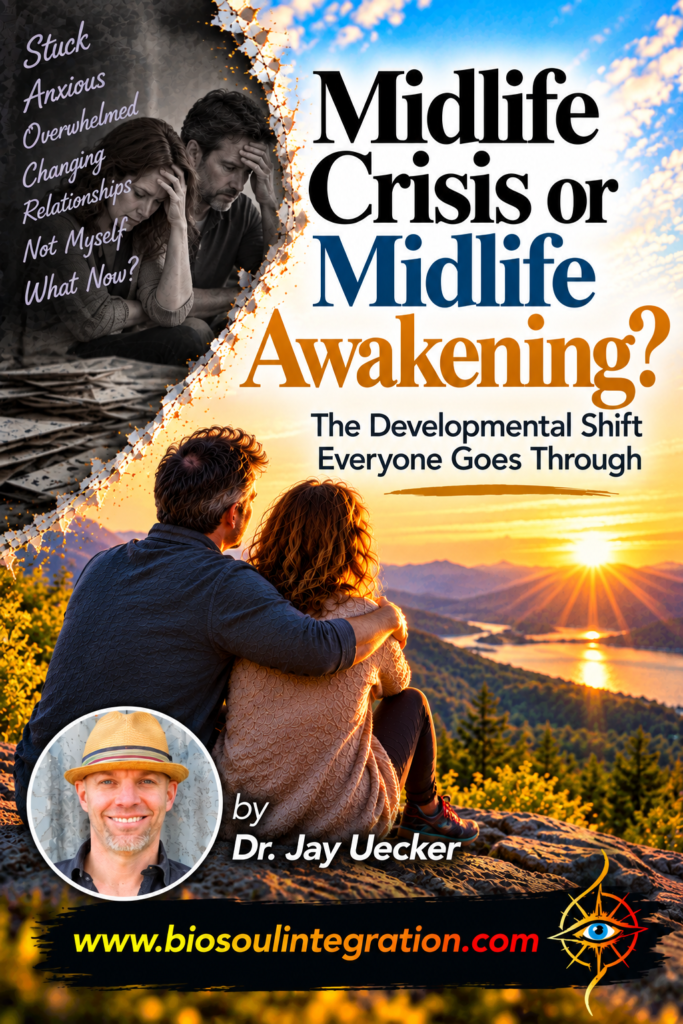
We talk a great deal about the crisis and much less about what this stage may be preparing us to become.
For women, there’s an ancient archetype: moving beyond the reproductive and caretaking stage to become a carrier and sharer of wisdom with the tribe.
Her value is less in what she produces or whom she cares for, and more in what she has lived, integrated, and come to know.
For men, the movement is from proving to guiding: from accumulating to sharing, accomplishing to understanding, and external validation to inner authority.
For both, the roles don’t necessarily disappear.
What changes is the source from which we inhabit them.
Less proving, performing, and forcing.
More expressing, guiding, creating, and sharing embodied wisdom.
So perhaps the question shifts.
Instead of how do I get back to who I was?
Try what is life trying to turn me into?
You don’t have to answer it intellectually.
You can simply listen, because the body may already know where life is trying to take you.
Frequently Asked Questions
How long does a midlife awakening last?
It varies, but it’s usually a process rather than a single event.
In the BioSoul perspective, the arc from disruption through integration can span roughly two seven-year stages, about fourteen years.
At what age does a midlife awakening begin?
Most people notice it somewhere in their 40s or 50s, though it can begin earlier or later.
It tends to follow years of building a life and identity.
Is a midlife awakening the same as a midlife crisis?
They can look and feel the same.
The difference is in how the experience is understood.
An awakening views the upheaval as part of a natural developmental shift you can participate in, rather than only a problem to fix.
Is a midlife awakening a medical or psychological diagnosis?
No.
It’s a way of describing and making sense of a common life transition, not a clinical diagnosis.
What helps most during a midlife awakening?
Approaches that build embodiment and presence, like somatic work, parts work, and other practices that let you feel rather than override, along with working one-on-one with someone experienced in this kind of transition.
The Spiritual Meaning of a Midlife Awakening: An Embodied Guide
A midlife awakening is more than a crisis. It’s a message from life itself, shaped by the nervous system, lived experience, and the soul’s unmet needs.
From a spiritual perspective, a midlife awakening often arrives when the identity that carried you through the first half of life can no longer hold what’s ready to emerge.
Years of survival patterns, adaptation, and setting parts of yourself aside can surface as restlessness, grief, exhaustion, and a sense that your old life no longer fits, not as failure, but as communication.

Embodied integration invites a different relationship with a midlife awakening.
Rather than pushing harder or trying to rebuild who you were, it asks us to listen.
Through nervous system safety, body-based awareness, and gentle reintegration of the parts of ourselves we once had to exclude, this transition becomes a process of returning to wholeness rather than escaping discomfort.
If you were intrigued by the concepts I talk about in this blog post, you’ll love my book, If It Didn’t Hurt: How To Resolve Your Pain And Discover Your Life Purpose.
Click the link to get a FREE pdf copy of my book.
Your body has wisdom. Let it guide you toward what life is trying to turn you into.
I look forward to helping you express more life,
Dr. Jay
About the Author Dr. Jay Uecker
Dr. Jay Uecker is the founder of the BioSoul Integration Center near Boulder, Colorado where he's been practicing for over 20 years. He’s an author, chiropractor, healer, and online soul integration coach who weaves Network Spinal Analysis, intuitive Parts Work, Brainspotting, SomatoRespiratory Integration, and body-centered awareness practices into his own technique, which he calls BioSoul Integration. His work helps people release unconscious resistance stored in the nervous system so they can embody their soul’s gifts and express their purpose more fully. Dr. Jay offers group healing sessions and one-on-one care, both in-person and online. He also offers a self-paced online course and a growing collection of transformational books. For a limited time, claim your FREE copy of If It Didn't Hurt: How to Resolve Your Pain and Discover Your Life Purpose.
Related Posts
How to Feel Safe in Your Body (When Nothing Else Has Worked)
What Does It Mean to Be Embodied? A Nervous-System Based Understanding of Embodiment
What Is Embodiment? How the Body Holds the Key to Healing and Wholeness
Embodiment: Living Fully Within Your Physical Form
How to Listen to Your Body: An Invitation to Sacred Presence
Somatic Embodiment: When Understanding Isn’t Enough