
Embodied Awareness: What It Is—and Why Thinking Your Way Through Healing Doesn’t Work

The body knows what the words cannot yet say.
Eugene Gendlin, author of Focusing
Knowng Isn’t the Same as Healing
That embodied somatic awareness piece is often the missing piece.
You’ve read the books.
You’ve done the therapy.
You understand your patterns, your triggers, your childhood wounds.
You can explain exactly why you feel the way you feel.
And yet—nothing is really changing.
If this sounds familiar, you’re not alone.
One of the most common struggles I see is awareness that remains conceptual rather than embodied.
People arrive exhausted, wondering why so much insight hasn’t translated into real healing.
Embodied awareness isn’t another technique to add to your toolkit.
It’s a fundamental shift in where awareness lives—away from the analyzing mind and into direct, felt experience in the body.
Until awareness is embodied, healing tends to remain an idea rather than something that’s actually lived.
What Is Embodied Awareness?
In this blog post, we’ll dive deep into what embodiment is by exploring both the concept of embodiment and the essence of healing itself.
Here’s a video I made about the deep subject of embodied healing:
If you prefer to listen to audio podcasts, the BioSoul Integration Podcast and this episode can be found wherever you listen to your audio podcasts:
Embodied awareness is awareness that includes sensation, not just observation.
It’s awareness felt from the inside, not directed at the body from the mind like a spotlight on a stage.
There’s a critical difference here that most people miss.
Thinking about the body is not the same as being in the body.
Talking about emotions is not the same as feeling them.
Visualizing healing is not the same as sensing directly what’s happening in real time.
Body awareness becomes somatic awareness when it drops below the level of concept and commentary.
When you’re truly present to sensation—the actual texture of what’s alive in you right now—you’ve crossed a threshold.
You’ve moved from analysis to experience.
Here’s the distinction that changes everything: Most people think they’re in their body—but they’re actually thinking about it from the neck up.
They’re narrating sensation, categorizing it, trying to figure out what it means.
That’s not embodied awareness.
That’s the mind trying to maintain control by staying one step removed from direct experience.
Why Awareness Alone Isn’t Enough
Mental awareness has its place.
It can help you recognize patterns, make connections, understand your history.
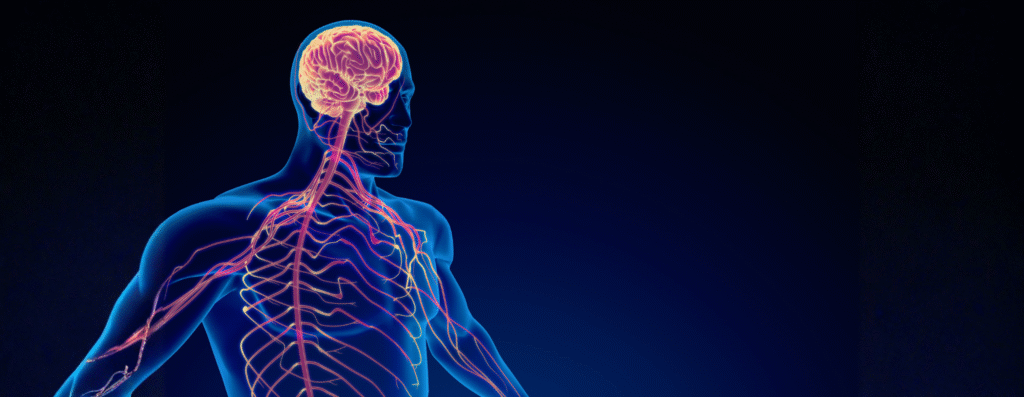
But awareness that stays mental doesn’t reach the nervous system—and the nervous system is where the unresolved material actually lives.
This is crucial to understand: the early patterns that shape your chronic symptoms, your emotional reactivity, your relational dynamics—these were formed before language and cognition.
They were encoded in a pre-verbal, body-based state.
You can’t think your way out of something that was never thought into existence in the first place.
Insight without embodiment actually reinforces control, not healing.
It gives the mind more material to work with, more ways to explain and manage, but it doesn’t create the safety necessary for the nervous system to release what it’s been holding.
This is why so many people experience “I’ve done so much work already” exhaustion.
They’ve been working hard—just in the wrong location.
The mind-body connection isn’t about understanding that your body and mind are connected.
It’s about living from that connection, letting awareness inhabit both simultaneously.
The Nervous System Is Always Listening
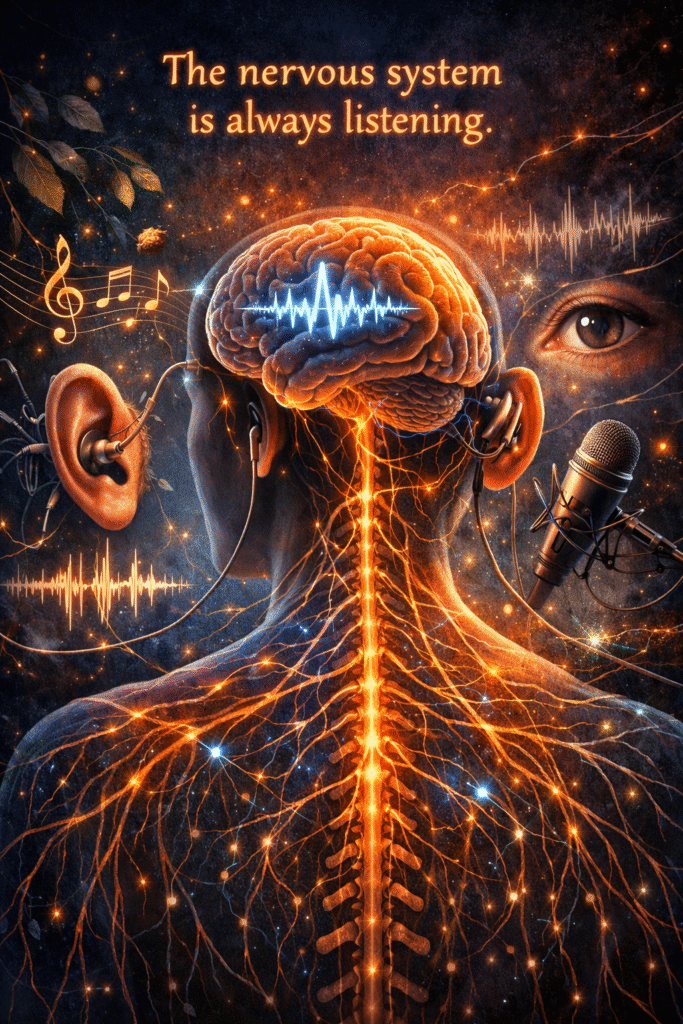
Here’s what makes embodied awareness so powerful: the body doesn’t respond to insight—it responds to safety and presence.
Your nervous system doesn’t care how well you can explain your anxiety.
It cares whether you’re here, now, with what’s actually happening.
Sensation is the nervous system’s language.
It’s how your body communicates what it needs, what it’s carrying, what’s trying to complete.
When awareness lands in sensation—when you’re genuinely present to the felt experience of being alive—something shifts.
Guarded patterns begin to soften.
Not because you’re trying to fix them, but because the presence itself creates a different context.
Life-force, which has been bound up in protection and vigilance, begins to reorganize around wholeness rather than threat.
This is where symptoms begin to change without force.
Not through willpower or technique, but through nervous system regulation that happens when the body feels met—not managed.
Healing happens when the body feels met—not managed.
That single shift dissolves years of struggle.
Why Most People Struggle With Embodied Awareness

Let me be honest about why this is difficult—not to discourage you, but to normalize what you might be experiencing.
Most people dip into sensation briefly, then pop right back into thought.
They touch the edge of a feeling, get uncomfortable, and retreat into analysis.
This happens so quickly and so automatically that they don’t even notice they’ve left.
They think they’re staying with the sensation, but they’re actually thinking about staying with it.
There’s a world of difference.
Others use awareness as a fixing tool instead of a listening tool.
They focus on sensation with an agenda: make this tension release, make this anxiety go away, make this pain stop.
But the body can feel that agenda, and it doesn’t feel like presence—it feels like more control.
So the very patterns you’re trying to shift actually tighten in response.
There’s also a subtle fear that lives in many people: What might surface if I actually stay?
What if the sensation gets bigger?
What if I can’t handle it?
This fear is rarely conscious, but it’s powerful enough to keep awareness at arm’s length from direct experience.
And finally, there’s cultural conditioning.
We’ve been taught that control equals safety, that figuring things out is how you solve problems, that the mind should be in charge.
Embodied awareness asks you to reverse that hierarchy—to let sensation lead and the mind follow.
That’s a radical shift for most nervous systems.
What Embodied Awareness Actually Feels Like

Let me ground this in something concrete, because embodied awareness doesn’t need to be mystical or poetic.
It’s remarkably ordinary once you know what you’re looking for.
You might notice a knot in your chest that begins to breathe on its own.
Not because you’re trying to breathe into it, but because your presence allows it to move.
You might feel heat, tingling, or pulsing in places that felt numb or absent before—signs that life-force is returning to areas that were shut down.
You might experience emotional clarity without emotional overwhelm.
A sadness that’s present but not consuming.
An anger that has contour and boundary.
A grief that can be held.
Often, what people report is simply this: less effort, more coherence.
Things that used to require enormous energy—managing moods, pushing through the day, staying connected in relationships—begin to happen with less strain.
Not because anything is fixed, but because you’re no longer fighting yourself at every turn.
Embodied awareness doesn’t feel dramatic.
It feels real.
And that realness, that sense of being inhabited from within, is what tells you you’re on track.
Embodied Awareness Is a Relationship, Not a Practice
This might be the most important reframe I can offer: embodied awareness is not something you “do for 10 minutes” and then return to your life.
It’s not a practice you check off your list.
It’s an ongoing dialogue with life through the body.
It’s a relationship you’re cultivating—one where you listen more than you direct, where you meet what’s present rather than imposing what should be.
From this perspective, symptoms aren’t problems to solve.
They’re communications from a system that’s trying to tell you something.
Pain, tension, fatigue, anxiety—these aren’t failures or flaws.
They’re the body’s way of signaling that something needs attention, space, or a different kind of response.
This ties into a larger worldview that I hold deeply: life is an intelligent process.
Your body is not an obstacle to overcome or a machine to optimize.
It’s an ally, carrying wisdom that precedes and exceeds your conscious understanding.
When you approach healing from this place, everything changes.
You stop trying to make yourself different and start listening to what’s already trying to emerge.
Embodied awareness is how you participate in that emergence.
It’s how you become a conscious partner in your own unfolding.
How to Begin Cultivating Embodied Awareness (Without Forcing It)

If you’re wondering where to start, keep it simple.
The entry point is gentleness, not effort.
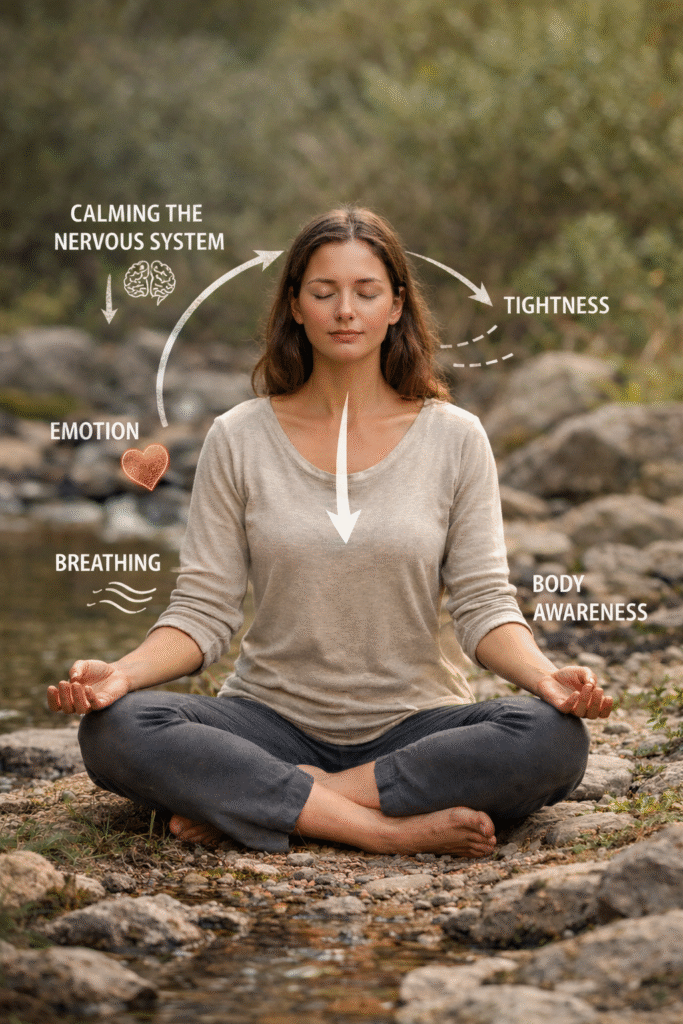
Pause and notice sensation before interpreting it.
When something arises—a tightness, a flutter, a heaviness—can you stay with the raw sensation for a few seconds before your mind labels it or explains it?
That brief pause is where embodiment begins.
Let the body lead the pace.
You don’t need to dive into the most intense sensation you can find.
In fact, that often backfires.
Start with what’s neutral—the weight of your body in the chair, the temperature of your hands, the movement of breath.
Let your nervous system learn that presence doesn’t mean overwhelm.
Stay with what’s neutral before approaching intensity.
This builds trust and capacity.
Your system learns that embodied awareness is safe, that sensation can be met without being consumed by it.
Notice where awareness naturally wants to land.
Sometimes your attention will be drawn to a particular place in your body.
Follow that.
There’s intelligence in where awareness is called.
Trust that over any prescription about where you “should” focus.
I’m not giving you a method here.
Methods can become another way the mind tries to control the process.
What I’m offering is an orientation—a way of being with yourself that prioritizes listening over managing, presence over performance.
When Embodied Awareness Changes Everything
I won’t make promises about what will happen for you.
Every nervous system is unique, every healing journey unfolds in its own time.
But I can tell you what becomes possible when embodied awareness deepens.
Physical symptoms that have been with you for years can begin to shift—not always completely, not always quickly, but in ways that feel like your body is finally participating in your life rather than sabotaging it.
Emotional reactivity decreases.
Not because you’re suppressing anything, but because you’re meeting feelings earlier in their development, before they build into overwhelming states.
There’s more space between trigger and response.
Decisions start arising from clarity instead of pressure.
You know what’s true for you because you can feel it, not just think it.
That inner compass, which may have been drowned out by anxiety or confusion, becomes clearer.
And perhaps most significantly, there’s a sense of being lived from within.
Of inhabiting your own life rather than watching it from a distance.
Of being a participant rather than a manager.
This is what shifts when awareness becomes embodied: the entire quality of your existence changes, not through force or technique, but through presence.
The Body Already Knows the Way
You don’t need more insight.
You don’t need to try harder.
You don’t need another framework or explanation.
What you need is awareness that’s willing to enter the conversation—to meet life where it actually lives, in the felt sense of this moment, in the sensations that are present right now.
Your body has been waiting for this.
It’s been signaling, communicating, calling you back home.
Not to fix anything, but to listen.
Not to change what’s wrong, but to be present to what is.
When awareness becomes embodied, healing stops being something you pursue—and starts becoming something that happens.
The Ultimate Embodied Awareness Guide
Embodied healing is a process of becoming whole by bringing awareness back to the parts of ourselves that were shaped by survival.
These patterns formed in the nervous system long before we could think our way out of them, and they don’t unwind through insight alone.
They resolve when they are met, felt, and included in awareness.
Life is continually inviting us into this kind of embodied awareness.

When we learn to listen to the body—rather than override it—we create the conditions for integration to occur naturally.
As the nervous system reorganizes, we experience greater stability, clarity, and a sense of being more at home in ourselves.
From this place, we don’t have to force change.
We live and act with more authenticity, because less of our energy is tied up in holding ourselves together.
If these ideas resonate with you, you’ll find a deeper exploration of them in my book, If It Didn’t Hurt: How To Resolve Your Pain And Discover Your Life Purpose.
Click the link above to get a FREE pdf copy of my book.
Exploring the Embodied Path: A Peek Into My Online Course
Here’s a video I made about the importance of embodiment and my embodied path online course:
I be remiss if I didn’t mention my embodied healing online course called “The Embodied Path Online Course: Eight Steps to Expressing Your Soul’s Essence, Purpose, and Calling.”
As the name suggests, there are eight basic exercises that are at the heart of the course.
The structure involves six simple yoga poses.
But these aren’t intense strengthening poses.
While it’s important to build core strength, we often forget the need to also cultivate deep relaxation as part of the process of embodiment.
These poses are based on that idea.
When the nervous system is in defense mode, strengthening exercises can create more protective armor.
Instead, the focus is on gentle movements, promoting ease and relaxation in specific parts of the body that are connected to our survival brain.
Click the link above to check it out.
I look forward to helping you express more life,
Dr. Jay
About the Author Dr. Jay Uecker
Dr. Jay Uecker is the founder of the BioSoul Integration Center near Boulder, Colorado where he's been practicing for over 20 years. He’s an author, chiropractor, healer, and online soul integration coach who weaves Network Spinal Analysis, intuitive Parts Work, Brainspotting, SomatoRespiratory Integration, and body-centered awareness practices into his own technique, which he calls BioSoul Integration. His work helps people release unconscious resistance stored in the nervous system so they can embody their soul’s gifts and express their purpose more fully. Dr. Jay offers group healing sessions and one-on-one care, both in-person and online. He also offers a self-paced online course and a growing collection of transformational books. For a limited time, claim your FREE copy of If It Didn't Hurt: How to Resolve Your Pain and Discover Your Life Purpose.
Related Posts
How to Feel Safe in Your Body (When Nothing Else Has Worked)
What Does It Mean to Be Embodied? A Nervous-System Based Understanding of Embodiment
What Is Embodiment? How the Body Holds the Key to Healing and Wholeness
Embodiment: Living Fully Within Your Physical Form
How to Listen to Your Body: An Invitation to Sacred Presence
Somatic Embodiment: When Understanding Isn’t Enough