We need to offer a gentle welcome to whatever surfaces.
Tara Brach, psychologist and author
When Understanding Emotions Isn’t Enough
You know exactly why you’re angry, anxious, or sad.
You can explain where the feeling comes from, and you may even have read a few books about it.
And still the same emotions keep returning, as though knowing the reason had never made a difference.
If that sounds familiar, you’ve probably discovered that understanding a feeling and processing it are not the same thing.
This guide walks you through how to process emotions in seven practical steps, drawing on the somatic and parts-based work I’ve done with people for roughly twenty years.
This guide goes a little further than most advice on the subject, because it treats emotions as more than something to name, release, and move past.
It approaches difficult emotions as expressions of parts of ourselves that are carrying pain, but also valuable energy, wisdom, and gifts.
Rather than trying to get rid of these feelings, we’ll explore how to turn toward them with curiosity and compassion, discover what they’re holding, and integrate what they have to offer into our bodies and lives.
Here’s a video I made on the topic of processing emotions:
If you prefer to listen to audio podcasts, the BioSoul Integration Podcast and this episode can be found wherever you listen to your audio podcasts:
Processing emotions means recognizing what you feel, experiencing it in the body, understanding it, and developing a new relationship with it so that its energy is no longer stuck.
It differs from suppression, which pushes a feeling out of awareness, and from rumination, which circles around it in thought without ever feeling it.
It also differs from emotional regulation, which is about calming yourself down, and from emotional release, which is about discharging a feeling through crying, shouting, or movement.
All of those have their uses, and none of them is quite the same as processing.
A helpful comparison is digestion.
Your body doesn’t just break a meal into pieces, it transforms it into something that nourishes you.
Emotional processing does something similar, taking a difficult experience and turning it into understanding, strength, and energy you can use.
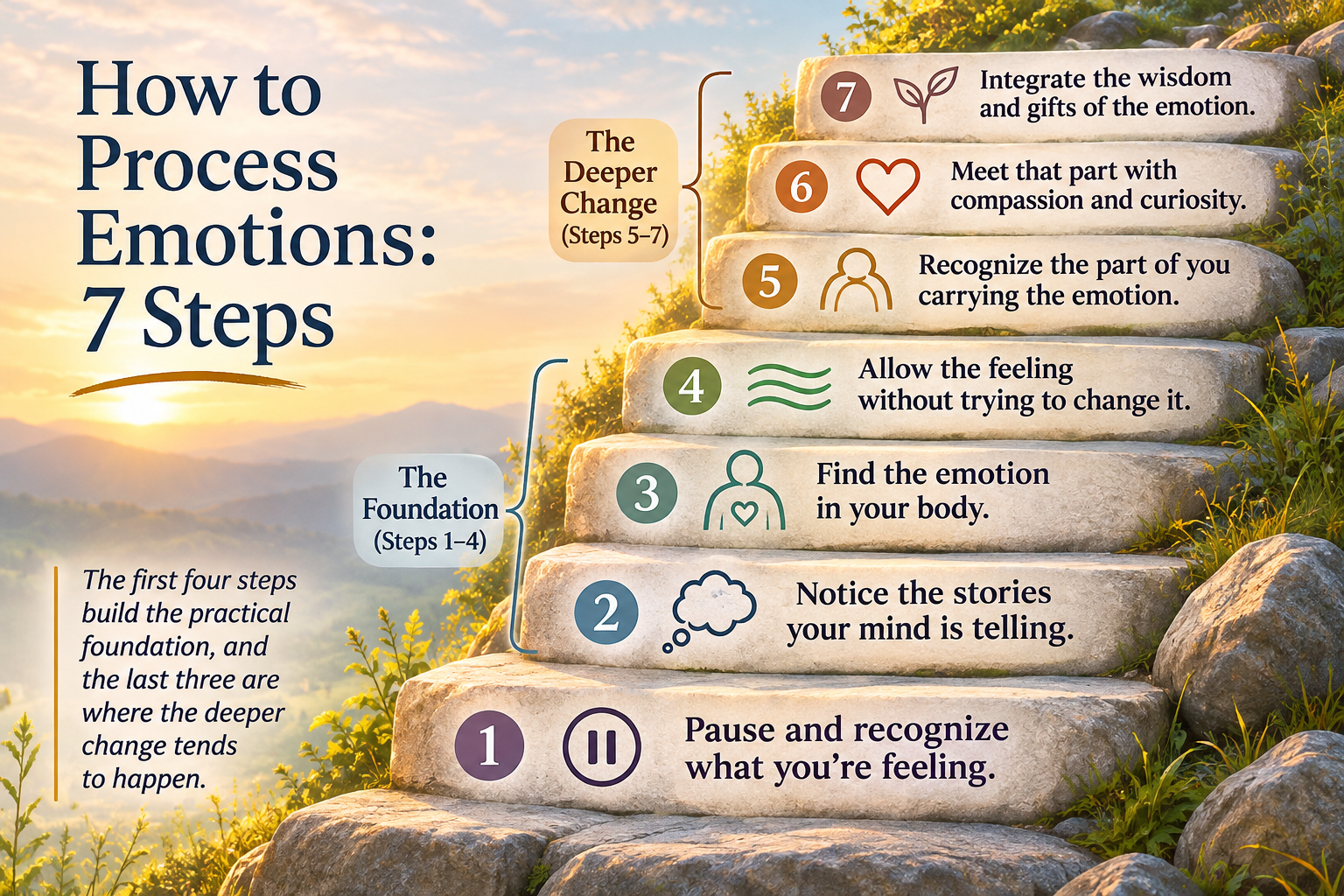
How to Process Emotions: 7 Steps
Here is the process at a glance, with a closer look at each step below.
Pause and recognize what you’re feeling.
Notice the stories your mind is telling.
Find the emotion in your body.
Allow the feeling without trying to change it.
Recognize the part of you carrying the emotion.
Meet that part with compassion and curiosity.
Integrate the wisdom and gifts of the emotion.
The first four steps build the practical foundation, and the last three are where the deeper change tends to happen.
Step 1: Pause and Recognize What You’re Feeling
The first step is simply to notice that an emotional reaction is underway before you do anything about it.
That might mean stopping mid-sentence, taking a breath, or telling yourself that something just got stirred up.
If you can, put a name to the feeling, whether it’s anger, fear, sadness, shame, or disappointment.
Naming an emotion is a useful starting point, but it’s only a starting point.
Many people stop here, feeling that they’ve dealt with the emotion because they’ve labeled it, and then wonder why nothing changes.
Step 2: Notice the Stories Your Mind Is Telling
Almost as soon as a feeling appears, the mind starts producing explanations, judgments, and predictions.
Why am I like this?
This always happens to me.
Something terrible is about to go wrong.
These stories can be valuable, but they can also act as a kind of shield, keeping us in our heads so we don’t have to feel what’s underneath.
For many of us that habit began in childhood, when feeling openly didn’t seem safe.
So the invitation here is gentle.
You don’t need to argue with the thoughts or silence them.
Just notice them, and begin to tell the difference between the story about the feeling and the feeling itself.
Step 3: Find the Emotion in Your Body
This step is where the work becomes truly different from analysis.
Bring your attention away from the story and into the physical sensation of the emotion.
Where do you notice it?
For many people it’s the chest, the belly, the throat, or the shoulders.
Once you’ve found it, explore it with curiosity.
How big is it, and what shape does it have?
Is it dense or light, warm or cool, still or moving?
Sometimes an image or a memory comes up along with it, and sometimes there’s simply a sensation with no words attached.
Either one is fine.
The body gives us a doorway into the emotional experience that thinking alone can’t open.
Step 4: Allow the Feeling Without Trying to Change It
Once you’ve found the sensation, see if you can make room for it exactly as it is.
That doesn’t mean forcing it to go away, and it doesn’t mean wallowing in it either.
Allowing is different from resignation, where you give up, and different from indulgence, where you feed the feeling with more story.
It’s closer to saying, you’re here, and I’m willing to be with you for a moment.
Approach it with curiosity rather than a goal, and stay for a short while without pushing for anything to happen.
If it starts to feel like too much, that’s useful information, and there’s a section below on what to do.
Make room for every part of you.
Step 5: Recognize the Part of You Carrying the Emotion
Here is where this guide begins to move beyond the standard advice.
When a strong emotion takes over, we tend to merge with it completely, so that we don’t feel that a part of us is afraid, we simply feel that we are afraid.
The fear becomes our entire point of view.
But when you’ve been attending to the sensation in your body, something subtle shifts.
You’re now aware of the fear, which means you can’t be only the fear.
Recognizing a part of me is afraid instead of I am afraid creates a little space between you and the experience, and that space is where everything else becomes possible.
You might even get an impression of the part itself, perhaps that it feels young, or tired, or like a wall that has been standing guard for years.
You don’t have to invent anything.
Just let whatever wants to be known show itself.
Step 6: Meet That Part With Compassion and Curiosity
Now notice how you feel toward the part.
Are you frustrated with it, wishing it would stop?
Are you afraid of it?
Or is there some real interest in understanding it?
That attitude matters more than almost anything else in the process.
Most of us have spent years trying to get rid of our difficult emotions, and the parts carrying them have felt that every time.
What they may need instead is for someone to wonder what they’ve been through, what they’ve been protecting you from, and what they need now.
When a part feels met in this way, often for the first time, the emotional experience can begin to change.
Nothing was forced, and yet the feeling softens, because the relationship itself has changed.
Step 7: Integrate the Wisdom and Gifts of the Emotion
The parts of us that carry pain also carry gifts, and those gifts are often hidden because of the pain.
Beneath chronic anger there may be a clear sense of justice and the strength to set healthy boundaries.
Within fear there may be a finely tuned discernment about what truly needs your attention.
And inside sadness there is often a deep capacity for empathy, tenderness, and connection.
As you meet these parts with care, those qualities can begin to come through in everyday life, rather than staying bound up in old patterns of protection.
That is what I mean by integration.
It isn’t about eliminating the emotion.
It’s about letting its wisdom become part of who you are, so that what once caused suffering becomes fuel for growth.
A Real-Life Example of Processing an Emotion
Suppose you send a message to someone important, and hours go by without a reply.
You feel a familiar wave of rejection, and your mind immediately starts to spin.
They’re ignoring me.
I said the wrong thing.
I always do this.
This is Step 2, noticing the stories, and just recognizing them as stories already loosens their grip a little.
Then you turn toward your body and find a tightness in your chest and a sinking feeling in your stomach.
You stay with those sensations for a few moments without trying to fix them.
As you do, you realize it isn’t quite right to say I am rejected.
It’s more accurate to say that a part of you is frightened of being left out.
When you turn toward that part with curiosity, you sense that it feels young, and that it learned long ago to brace for exactly this kind of silence.
You let it know that you see it, and that you’re here.
Something in your chest softens.
The message hasn’t been answered, but you’re no longer being driven by the fear, and you can decide with a clearer mind whether to wait, reach out again, or let it go.
Why Is It So Hard to Process Emotions?
If this all sounds simple, it’s worth saying that it often isn’t, and there are good reasons for that.
Many of us were taught early on that certain feelings weren’t welcome, whether anger, sadness, or fear, so we learned to avoid them.
Our thinking minds became very good at keeping us busy, analyzing, and in control.
Strong sensations can also be uncomfortable to stay with, especially if the body has learned to associate them with danger.
It helps to remember that this isn’t a personal failing.
What can look like unwillingness to feel is often a protective part doing its job, trying to keep you safe in the only way it knows how.
When you approach it with respect instead of pressure, it usually becomes much more willing to relax.
Emotional Release vs. Emotional Processing vs. Integration
These three terms are often used as if they mean the same thing, so here’s how I think about the difference.
Approach
Primary focus
Emotional release
Expressing or discharging feelings
Emotional processing
Experiencing and understanding feelings
Emotional integration
Transforming your relationship with emotional parts and embodying their gifts
These approaches aren’t mutually exclusive.
Release can be a valuable part of processing, and there are times when it’s exactly what’s needed.
But it isn’t always the endpoint, and relying on it alone can quietly become another way of trying to get away from a feeling.
What to Do When an Emotion Feels Overwhelming
There’s no need to push through an experience that feels like too much.
You can look around the room and name a few things you see.
You can feel your feet on the floor and notice the support beneath you.
You can take a break, drink some water, or step outside for a few minutes.
Then, when you have more capacity, you can come back to it.
The point is not to force yourself to feel more, but to build a different relationship with what you’re already feeling, and that happens best at a pace your system can handle.
If you’re working with trauma or very intense emotions, it can also help to have the support of a trained practitioner.
How Do You Know You’re Actually Processing Your Emotions?
The goal isn’t for feelings to disappear, so the signs of progress look a little different than you might expect.
You may notice that you react less automatically when something triggers you.
You may find more compassion for yourself, especially toward the parts of you that you used to criticize.
You may be able to stay present with strong feelings for longer, set healthier boundaries, and feel more freedom in how you choose to respond.
The emotions themselves may still come, but they don’t run the show in quite the same way.
Frequently Asked Questions About How to Process Emotions
How do you process emotions instead of suppressing them?
Start by pausing and bringing attention into your body, so you’re feeling the emotion rather than pushing it away or thinking around it.
Then let it be there with some curiosity.
How long does it take to process an emotion?
There’s no fixed timeline.
Some feelings shift in a few minutes of focused attention, while others, especially ones connected to old experiences, take place over weeks or months.
Can you process emotions without crying?
Yes.
Tears can be part of the process for some people, but they aren’t required, and processing can happen through quiet awareness, sensation, and understanding.
Why do the same emotions keep coming back?
Often because the part carrying them hasn’t yet had the chance to be met in the way it needs.
Understanding the feeling doesn’t resolve it, but a new relationship with it can.
How do you process emotions when you don’t know what you’re feeling?
Start in the body rather than the mind.
Notice any tightness, heaviness, or tension, and stay with the sensation for a while.
The name for the feeling often becomes clear on its own.
What’s the difference between processing emotions and overthinking them?
Overthinking happens in the head, analyzing and explaining, while processing involves feeling the emotion directly in the body and changing how you relate to it.
Processing Emotions Is About Transformation, Not Elimination
Learning how to process emotions isn’t about getting rid of what’s uncomfortable.
It’s about discovering what those uncomfortable feelings have to offer.
Difficult emotions aren’t necessarily problems to be solved.
They can be doorways into parts of ourselves that carry not only pain, but also valuable wisdom, energy, and gifts waiting to be discovered.
What if the very things you’ve been trying to get rid of are actually holding something you need?
That’s the central idea behind my book, If It Didn’t Hurt: How to Resolve Your Pain and Discover Your Life Purpose.
In it, I explore how our emotional and physical pain can become a doorway to deeper self-understanding, healing, and the discovery of the gifts we’re here to bring into the world.