
What Does It Mean to Be Embodied? A Nervous-System Based Understanding of Embodiment

The body keeps the score. If the mind does not heal, the body remembers.
Bessel van der Kolk, author of The Body Keeps the Score
Understanding Embodiment Beyond the Buzzwords
The word embodied gets used constantly in wellness and spiritual growth circles, yet it often remains vague and poorly defined.
Some people associate it with mindfulness or meditation.
Others think of it as feeling calm, centered, or emotionally balanced.
Yet many who have spent years on a spiritual or personal growth path sense that embodiment points to something deeper—something about actually living their values, awareness, and inner truth through the body, not just understanding them.
So what does it really mean to bring spiritual insight into lived, physical experience?
Why do so many thoughtful, introspective people still feel disconnected from their bodies despite doing so much inner work?
Let’s look at this more concretely.
Embodiment Exists as a Nervous System Experience, Not an Intellectual Framework
Here’s a video I made on embodied healing:
If you prefer to listen to audio podcasts, the BioSoul Integration Podcast and this episode can be found wherever you listen to your audio podcasts:
Fundamentally, embodiment isn’t about acquiring knowledge of your physical form.
It centers on whether your nervous system registers sufficient safety to fully occupy your body.
You might comprehend the roots of your tension.
You might recognize patterns formed during childhood.
You might understand how your physical responses carry deeper significance.
Yet you may still lack embodiment.
Embodiment doesn’t emerge from understanding alone.
It develops when protective mechanisms in your nervous system no longer maintain constant vigilance.
As safety increases, your awareness naturally descends from mental loops into bodily sensations—effortlessly.
Why Highly Conscious People Often Feel Physically Disconnected

I frequently encounter individuals who possess remarkable insight, eloquence, sensitivity, and spiritual depth—while remaining profoundly detached from their bodies.
This disconnect doesn’t indicate inadequacy.
It typically reflects adaptive intelligence from early life.
Many people discovered as young children—sometimes preverbal—that fully experiencing their physical and emotional reality felt threatening.
Their awareness evolved accordingly.
It shifted upward into cognitive realms.
It became focused on analysis rather than direct experience.
It learned to monitor sensations from a distance rather than inhabiting them.
This adaptation creates an internal division.
The intellect becomes exceptionally refined.
The body becomes something to control, repair, bypass, or spiritually transcend.
Externally, this pattern can resemble presence.
Internally, it resembles floating outside yourself.
Embodiment emerges as this division begins to mend.
The Practical Reality of Being Embodied
Being embodied doesn’t guarantee perpetual tranquility.
It doesn’t promise immediate symptom resolution.
It doesn’t mean never experiencing dissociation or bodily tension.
It involves staying with physical sensations rather than rushing to analyze them.
It means experiencing emotions as bodily energy rather than exclusively as narratives.
It requires noticing when parts of you clench, guard, or retreat—without forcing them to change.
It shifts your orientation from external validation to internal wisdom.
An embodied individual doesn’t dominate their nervous system.
They develop a listening relationship with it.
Gradually, the nervous system reciprocates by releasing defensive patterns.
Embodiment Requires Reclaiming Exiled Aspects of Self

Another essential perspective on embodiment involves this truth.
You become embodied as previously rejected parts of yourself find safe reentry into awareness.
Various aspects learned early lessons.
“This intensity is unbearable.”
“This desire is unacceptable.”
“This requirement is hazardous.”
These parts didn’t vanish entirely.
They relocated into bodily storage beyond conscious reach.
Embodiment unfolds when awareness expands enough to accommodate these parts without attempting to modify them.
This explains why embodiment frequently accompanies sensations in waves.
Emotional intensity may surge unexpectedly.
Old behavioral patterns might temporarily amplify.
This process isn’t backsliding.
It’s reintegration of fragmented self.
The Impossibility of Manufacturing Embodiment

A common misconception assumes embodiment is something you can directly accomplish through willpower.
This assumption is incorrect.
You can establish conditions that support embodiment—but embodiment itself emerges as a byproduct of nervous system safety.
This explains why deliberately “dropping into your body” frequently produces opposite results.
For a nervous system shaped by early adversity, commands to feel more intensely can register as danger.
The body relaxes its defenses when it feels genuinely acknowledged—not when pressured.
This dynamic explains why many people alternate between fleeting embodied moments and extended periods of disconnection.
The system continuously evaluates its environment.
“Can I trust this safety to persist?”
Reliable presence, patience, and attuned attention outweigh any specific technique.
Embodiment Unfolds Developmentally Rather Than Performatively

Embodiment isn’t a fixed characteristic.
It’s not a quality you either possess or lack.
It represents an ongoing developmental journey.
As your nervous system matures and reorganizes its patterns, awareness naturally penetrates deeper bodily layers.
Initially stabilizing foundational safety.
Subsequently expanding into broader sensory awareness.
Then enabling authentic self-expression.
Eventually allowing genuine rest.
Embodiment doesn’t arrive through conforming to idealized standards.
It develops by permitting your system to complete interrupted developmental processes from earlier life stages.
Recognizing the Shifts That Accompany Deepening Embodiment
As embodiment progresses, people typically observe subtle yet significant transformations.
Reduced compulsion to constantly improve themselves.
Boundaries that establish themselves naturally without deliberate effort.
Greater honesty in communication, even when uncomfortable.
A sensation of inhabiting yourself rather than managing yourself from outside.
Physical symptoms often persist—but they cease dictating your entire experience.
Existence shifts from feeling like something imposed upon you toward something flowing through you as an active participant.
A Closing Perspective
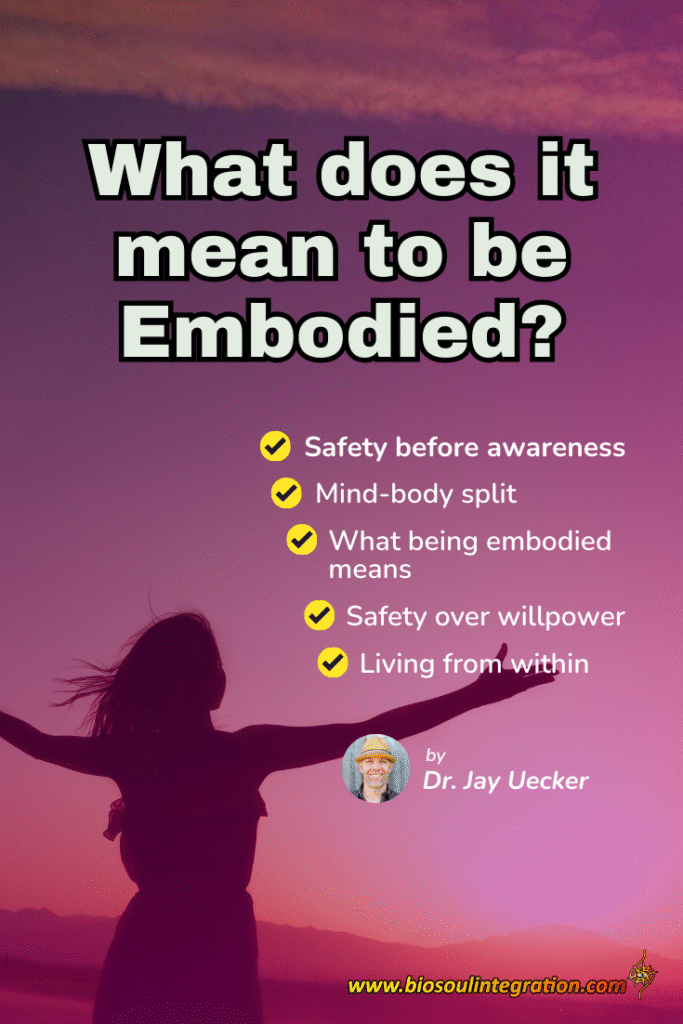
What does being embodied ultimately mean?
It means your nervous system no longer requires fragmented awareness as a survival mechanism.
It means the protective intelligence that once shielded you can finally release its grip—allowing your complete arrival in the present moment.
Embodiment isn’t an achievement or destination.
It’s a permission your system grants itself when protection from your own experience becomes unnecessary.
When this permission unfolds, your body transforms from a dilemma requiring solutions into the foundation from which you live.
The Ultimate Embodied Awareness Guide
Embodied healing is a process of becoming whole by bringing awareness back to the parts of ourselves that were shaped by survival.
These patterns formed in the nervous system long before we could think our way out of them, and they don’t unwind through insight alone.
They resolve when they are met, felt, and included in awareness.
Life is continually inviting us into this kind of embodied awareness.

When we learn to listen to the body—rather than override it—we create the conditions for integration to occur naturally.
As the nervous system reorganizes, we experience greater stability, clarity, and a sense of being more at home in ourselves.
From this place, we don’t have to force change.
We live and act with more authenticity, because less of our energy is tied up in holding ourselves together.
If these ideas resonate with you, you’ll find a deeper exploration of them in my book, If It Didn’t Hurt: How To Resolve Your Pain And Discover Your Life Purpose.
Click the link above to get a FREE pdf copy of my book.
Exploring the Embodied Path: A Peek Into My Online Course
Here’s a video I made about the importance of embodiment and my embodied path online course:
I be remiss if I didn’t mention my embodied healing online course called “The Embodied Path Online Course: Eight Steps to Expressing Your Soul’s Essence, Purpose, and Calling.”
As the name suggests, there are eight basic exercises that are at the heart of the course.
The structure involves six simple yoga poses.
But these aren’t intense strengthening poses.
While it’s important to build core strength, we often forget the need to also cultivate deep relaxation as part of the process of embodiment.
These poses are based on that idea.
When the nervous system is in defense mode, strengthening exercises can create more protective armor.
Instead, the focus is on gentle movements, promoting ease and relaxation in specific parts of the body that are connected to our survival brain.
Click the link above to check it out.
I look forward to helping you express more life,
Dr. Jay
About the Author Dr. Jay Uecker
Dr. Jay Uecker is the founder of the BioSoul Integration Center near Boulder, Colorado where he's been practicing for over 20 years. He’s an author, chiropractor, healer, and online soul integration coach who weaves Network Spinal Analysis, intuitive Parts Work, Brainspotting, SomatoRespiratory Integration, and body-centered awareness practices into his own technique, which he calls BioSoul Integration. His work helps people release unconscious resistance stored in the nervous system so they can embody their soul’s gifts and express their purpose more fully. Dr. Jay offers group healing sessions and one-on-one care, both in-person and online. He also offers a self-paced online course and a growing collection of transformational books. For a limited time, claim your FREE copy of If It Didn't Hurt: How to Resolve Your Pain and Discover Your Life Purpose.
Related Posts
The Spiritual Root of Anger: Discovering Its Hidden Power
What Is Embodiment? How the Body Holds the Key to Healing and Wholeness
Embodiment: Living Fully Within Your Physical Form
How to Listen to Your Body: An Invitation to Sacred Presence
Somatic Embodiment: When Understanding Isn’t Enough
Embodied Awareness: What It Is—and Why Thinking Your Way Through Healing Doesn’t Work