
Discover How to Heal Spiritual Pain and Find Inner Peace: A Guide To Transformation
The “Cost” Of Healing

Everyone’s concerned with what they’ve got to give to get something that they want, and this goes for healing spiritual pain, as well.
I meet a lot of people through my healing practice who want to get out of pain but they don’t want to sacrifice anything.
Life, and healing, doesn’t work like that–there’s always a cost.
Healing spiritual pain, or any kind of pain for that matter, will require that we “pay” attention.
Fortunately our attention is a resource that’s abundantly available.
Our attention contains an enzyme of sorts that acts as a catalyst.
When we focus our attention on what our pain FEELS like in our bodies, our attention catalyzes the process of healing and integrating the energy that is bound up in our pain–speeds that process up and lubricates it.
How to Heal Pain Through Attention
Is it really possible to heal pain simply by focusing on it?
Well, first you have to understand what healing means.
The word heal comes from an Old English word which means “to make whole.”
Healing refers to the process of becoming “whole,” the process of integating our mind, body and soul.
The truth is that we’re already whole.
It’s just that we’ve kind of forgotten.
We have been taught, unconsciously, by life and the people around us, to push away or separate parts of ourselves that we’ve learned are not valid or safe to feel.
Life Imitates Life
In the early stages of our development, while we are in the womb and during the first few years of life, our nervous systems are very malleable and sensitive to the nervous systems of those around us.
We’re like little sponges soaking up information from the world around us.
When we feel into those around us we sense that they have dishonored and and disconnected from parts of themselves.
Their spiritual sides are not being expressed through their physical bodies.
We naturally assume that this is how to be human.
Because we rely on those around us for our survival we instantly and unconsciously adopt the same way of being out of a perceived need to survive.
A key to forgetting that we’re whole is to remove our attention from the parts of us that we’e been led to believe by others are not safe.
Turning away from parts of ourselves in this way becomes a habit.
Life Can Become Exhausting

Life, on the other hand, is constantly trying to drive our unconscious parts to the surface of our awareness.
The resources that we use to keep our disowned and dishonored parts unconscious are resources that we don’t get to use for growing new cells, digesting food and turning it into fuel, fighting off germs and diseases that make us sick, and adapting to our environment.
Consequently just living on a day to day basis can become exhausting.
Life Has a Way of Making Us Look at Ourselves
Life has a way of making us look at ourselves in the mirror.
To take a closer look at those parts of ourselves that we have thought of as inferior or defective to bring us together to reintegrate those parts.
Actually it’s unavoidable because we WILL run into people and situations that will cause us to reflect on those parts of ourselves.
The life-force energy associated with our disowned and dishonored parts might arise as joint pain, back pain, digestive issues, or some other type of pain, because pain is an excellent way to draw our attention.
That pain gets our attention and we are forced to focus on it.
And that is what dissolves that separation.
Pain Is An Opportunity

A lot of people I meet in the course of doing my work who are experiencing pain will say, “Oh, it’s got my attention, all right. I’m listening, all right.”
Usually what that means, though, is that they’re wrapped up in the thoughts about the pain and in trying to figure out how to escape from it.
They’re seeing it as something that’s getting in the way of them living their lives the way they think they’re life should look.
But Life often has something in mind that’s much greater than what we can conceive of and pain is part of getting us to see that.
They may decide to ignore it or take some medication in an attempt to take the pain away.
If they succeed it’s usually only temporary.
When we push pain away it tends to push back.
Pain will likely come back as some other problem later on.
Maybe we suppress physical pain today, which shows up as an organic problem later, digestive issues or diabetes or high blood pressure, the list goes on and on.
Maybe we suppress an organic problem today only to end up with a psychological problem tomorrow, depression, anxiety or anger.
The disowned, suppressed part of ourselves and the energy associated with it will not just go away.
It will get bigger and louder until we have no choice but to listen and pay attention to it.
OK, So How Do We Pay Attention To Pain?
Here’s a video I made on the subject:
If you’d rather listen here’s a podcast version:
Paying attention means taking a good look at ourselves, focusing inward and allowing ourselves to feel those sensations and feelings that we have been trying to push away.
Giving ourselves permission to feel the feelings associated with pain catalyzes a reaction that integrates the life force energy that’s bound up in the pain.
Some people feel like they don’t know how to feel the sensations in their body.
When clients say that to me I ask them to close their eyes and ask them this question: Do you have a body?
They always answer yes.
I say, “How do you know you have a body?”
They know they have a body because they can feel it.
Physical Sensations
There are only three kinds of sensations in the body that tend to be all tangled up like a knot.
First there’s physical sensations.
Physical sensations can include the pressure of your bottom on the seat or the touch of your clothes on your skin.
Sensations are also caused by pain or tension or heat or cold or energy moving.
Physiological Sensations
Then there are physiological sensations, those caused by your organs doing their thing: the feeling of your heart beating or the sensation of your breathing or your stomach gurgling or a full bladder.
Emotional Sensations
And lastly emotions have a sensational quality in the body: anger might make you feel hot, fear might cause your chest or stomach to feel tight, grief might make you feel heavy (overburdened), joy might have an effervescent and uplifting quality.
In any given moment you should be able to feel at least one of either physical, physiological or emotional sensations in your body.
Working With Pain
There’s a good chance that if you’re reading this it’s because you’re experiencing pain in your body or your being.
Take this opportunity to focus your attention on it.
Notice Exactly Where It Is
What are the boundaries like? Are they clearly defined or fuzzy? Does it have shape or volume.
Notice Any Quality Of Movement
Is there pressure (either pushing out or pushing in or some combination of the two)? Is it expanding or collapsing?Is it vibrating or throbbing or stabbing?
Notice Any Other Qualities Or Characteristics
Does it have color? Does it have texture? Does it feel like some material: plastic, gum, slime, etc? Does it feel like an element: fire, water, wood, earth, air, etc? Is it smooth or rough or wet. Does it have temperature?
Breath It Into Your Heart
Our hearts can transmute anything.
Seeing and feeling the sensation of pain through the lens of the heart creates a state known as “presence” that allows us to unpack the wisdom of the bound up energy in pain.
Let It Go

Now let it all go.
Let yourself do whatever feels natural.
Give yourself a break for 5 to 10 minutes and then come back to it.
When you return to your focused attention does it feel different than the first time?
Is the pain less intense, or are the feelings associated with the pain different?
Any change, even if it’s gotten more intense, is still a change and that means that you are making progress towards resolving your pain.
This method of bearing down and then easing up is similar to how you might massage a knot loose.
The Ultimate Guide To Healing Pain
If It Didn’t Hurt: How To Resolve Your Pain And Discover Your Life Purpose is the ultimate guide to turning your pain into a portal to soul.
Pain is intelligent, bound up energy that really just wants to share its wisdom with you.
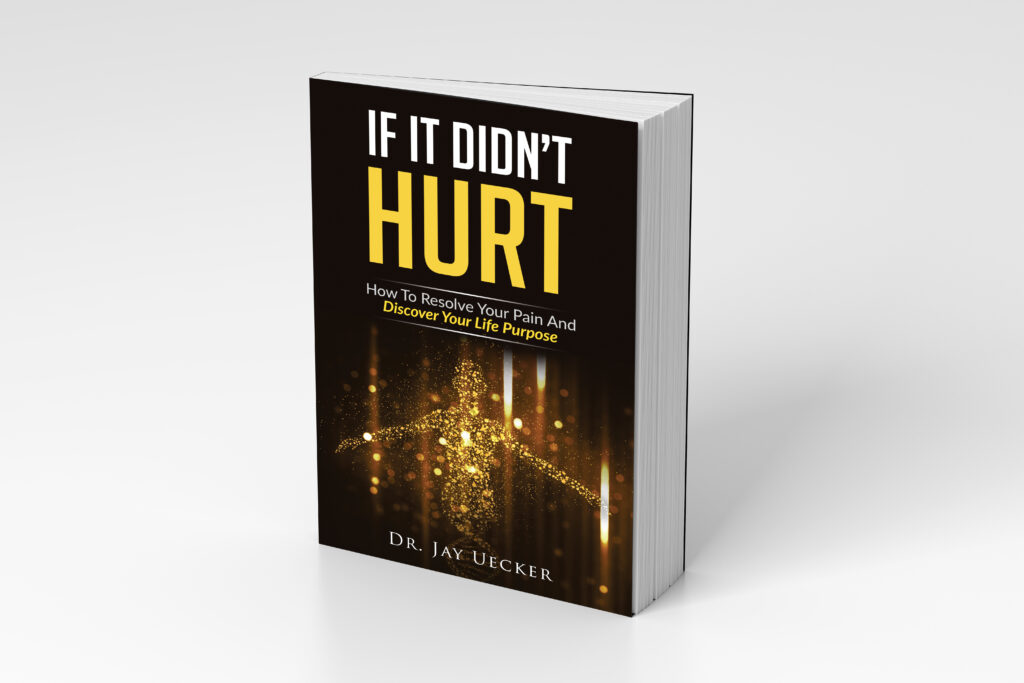
This book shares the knowledge gained from decades of experience in private practice, actual client stories of healing and exercises designed to help you experience what’s possible when you’re willing ot turn your heart and your attention toward your pain: It becomes a portal that leads to a place in you where the illusion of separateness collapses and the parts of your body and soul that have been disconnected are reunited.
Click the link to buy my book and/or read the first chapter for FREE instantly.
I look forward to helping you express more life,
Dr. Jay
About the Author Dr. Jay Uecker
Dr. Jay Uecker is the founder of the BioSoul Integration Center near Boulder, Colorado where he's been practicing for over 20 years. He’s an author, chiropractor, healer, and online soul integration coach who weaves Network Spinal Analysis, intuitive Parts Work, Brainspotting, SomatoRespiratory Integration, and body-centered awareness practices into his own technique, which he calls BioSoul Integration. His work helps people release unconscious resistance stored in the nervous system so they can embody their soul’s gifts and express their purpose more fully. Dr. Jay offers group healing sessions and one-on-one care, both in-person and online. He also offers a self-paced online course and a growing collection of transformational books. For a limited time, claim your FREE copy of If It Didn't Hurt: How to Resolve Your Pain and Discover Your Life Purpose.
Related Posts
Anger and Spirituality: Why Your Anger Is Not Opposed to Your Awakening
Anger and Healing: Why Feeling Your Anger Is One of the Deepest Forms of Medicine
The Root Causes of Anger: How Suppressed Life-Force Turns Into Frustration, Rage, and Pain
The Power of Anger: How Life-Force Energy Becomes Clarity, Boundaries, and Inner Knowing
The Spiritual Root of Anger: Discovering Its Hidden Power
How to Feel Safe in Your Body (When Nothing Else Has Worked)